Tell us about the job
Takes about a minute. No obligation.
A contractor called out to repair a central AC system in Page County has to separate what the climate has ground down from what poor maintenance or a bad installation broke. 116 severe weather events were recorded in Page County, Virginia between 2015 and 2024. At that rate, severe weather is a standing condition of operating here, and compressor valves, capacitors, and contactor points all carry that load season after season. A part that failed because it was simply exhausted needs replacing. One that failed because refrigerant was running low or airflow was blocked points to a different repair scope and a different bill.
Ductwork and electrical in a house this old were put in long before the system running in it today was built, but for repair work that gap is a secondary concern. Half the homes in Page County, Virginia were built in 1974 or earlier (2020-2024 ACS 5-year). What a contractor finds once the unit is open matters more: whether a failed capacitor, contactor, or control board still has a current replacement part, or whether the system has aged past what the supply chain still stocks. A house that old often contains a central AC unit that is itself old enough to make that question real.
The Parts of a Central AC a Contractor Checks First
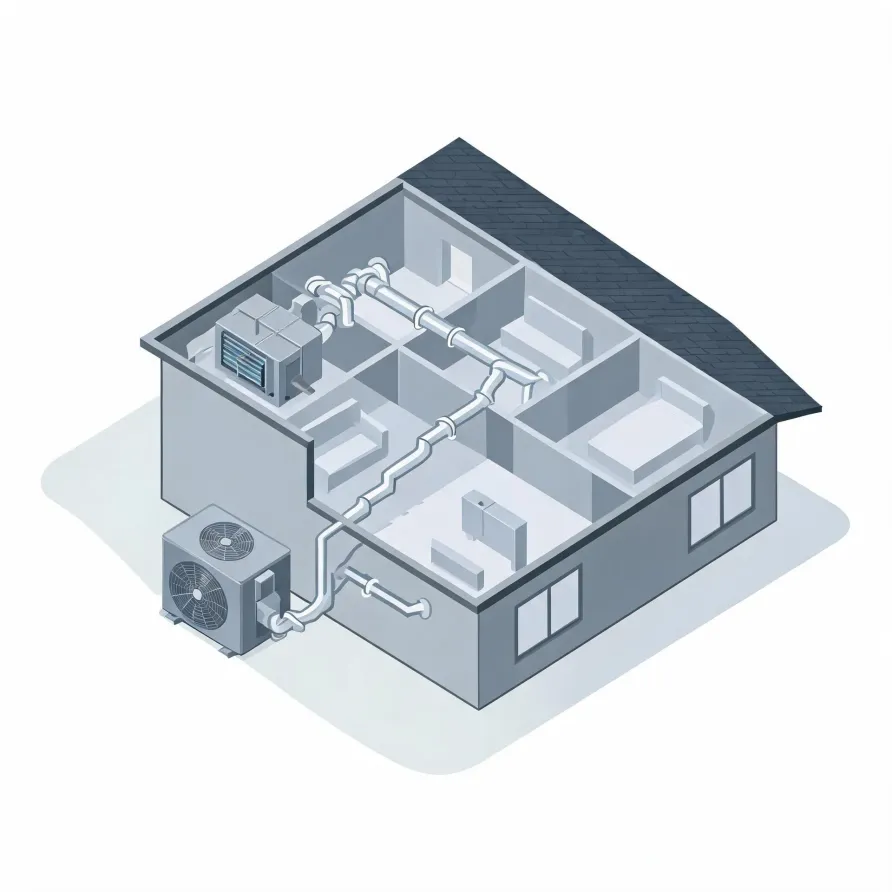
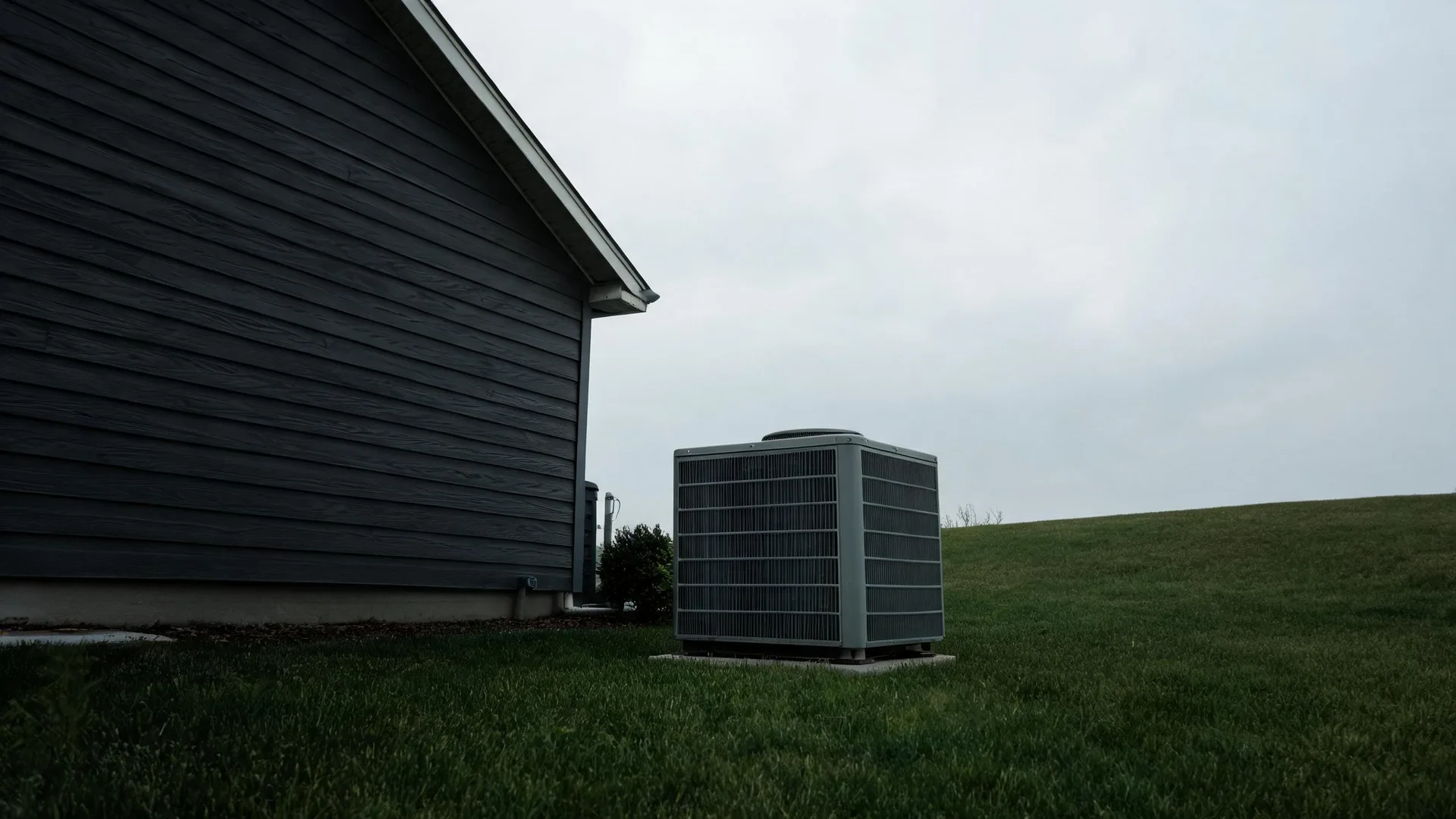
The outdoor condenser unit sits on a pad beside the house and holds the compressor and condenser coil. These are the parts a contractor reaches first when a system stops cooling. The compressor drives the whole cycle, so when it fails, nothing else can compensate for it.
Inside the house, the air handler or furnace cabinet holds the evaporator coil and the blower. The evaporator coil is where the cooling actually happens, and a refrigerant leak or a frozen coil points a contractor straight to it. The blower moves conditioned air into the duct system, and a failed blower motor means air stops moving regardless of what the rest of the system is doing.
The drawing shows the general layout of a central AC system, and a licensed contractor determines what applies to the specific equipment and configuration in your house.
Get matched in Page CountyPage County, Virginia, by the numbers
116 severe weather events were recorded in Page County, Virginia between 2015 and 2024.
NOAA National Centers for Environmental Information, Storm Events Database, bulk CSV export, events 2015-01-01 through 2024-12-31.Half the homes in Page County, Virginia were built in 1974 or earlier (2020-2024 ACS 5-year).
U.S. Census Bureau, 2020-2024 American Community Survey 5-Year EstimatesPage County, Virginia holds 11,955 housing units (2020-2024 ACS 5-year).
U.S. Census Bureau, 2020-2024 American Community Survey 5-Year EstimatesOwners occupy 71.8% of the occupied homes in Page County, Virginia (2020-2024 ACS 5-year).
U.S. Census Bureau, 2020-2024 American Community Survey 5-Year EstimatesRules & Standards Governing Central AC Repair in Page County, Virginia10 sourced rules and standards
What HVAC Repair Looks Like in Page County
Split-system central air conditioners rated below 45,000 Btu/h manufactured on or after January 1, 2023 must meet a federal minimum of 13.4 SEER2.
Split-system central air conditioners rated at or above 45,000 Btu/h manufactured on or after January 1, 2023 must meet a federal minimum of 13.4 SEER2.
Split-system central air conditioners manufactured between January 1, 2015 and December 31, 2022 had to meet 13 SEER, the metric that preceded SEER2.
Single-package central air conditioners manufactured on or after January 1, 2023 must meet a federal minimum of 13.4 SEER2.
Space-constrained central air conditioners manufactured on or after January 1, 2023 must meet a federal minimum of 11.7 SEER2.
Federal efficiency standards for split-system central air conditioners and heat pumps are set on each certified combination of outdoor unit and indoor coil rather than on the outdoor unit alone.
Residential and light commercial air conditioning and heat pump systems assembled in the field, including mini-splits and unitary systems, may not be installed on or after January 1, 2025 using a refrigerant with a global warming potential above 700.
A field-assembled system whose specified components were all manufactured or imported before January 1, 2025 carries no installation compliance date under the refrigerant restrictions and may still be installed.
Licensing Rules for HVAC Repair in Page County, Virginia
Virginia’s contractor licence classes start above $1,000: the entry class covers a single contract or project over $1,000 but less than $30,000, or less than $250,000 of work in any 12-month period, with larger classes above that.
Virginia requires a contractor licence: no person may engage in, or offer to engage in, contracting work in the Commonwealth without one.
Severe Weather Events in Page County
Weather puts real hours on cooling equipment. Every event that pushes temperatures to an extreme or cuts power and restores it forces the system to cycle hard, and that cumulative load is what drives repair needs in any given area.
116 severe weather events, 2015–2024. Source: NOAA National Centers for Environmental Information, Storm Events Database.