Tell us about the job
Takes about a minute. No obligation.
A contractor called out to repair a central AC in Williamsburg is not walking into a system beaten down by relentless weather. 21 severe weather events were recorded in Williamsburg city, Virginia between 2015 and 2024. At that rate, severe weather is an event in this area, not a condition, and most residential systems here have not accumulated the kind of storm-driven wear that would push components to failure on its own. What a contractor finds in a failed compressor or a seized contactor is far more likely to trace back to age, poor original installation, or skipped service than to anything the sky has done. The weather record is real, but it rarely carries the weight of a diagnosis here.
Ductwork in a house built for an earlier era of cooling gets adapted over time, and the central AC system running in it today reflects those layered changes. Half the homes in Williamsburg city, Virginia were built in 1987 or earlier (2020-2024 ACS 5-year). When a contractor opens a system in stock like this, the question that shapes the repair is whether the failed component is still manufactured. If it is not, the job changes scope before a part is ever ordered. Sourcing, substitution, or a broader repair decision follows from what the opened unit actually contains.
The Parts of a Central AC a Contractor Checks First
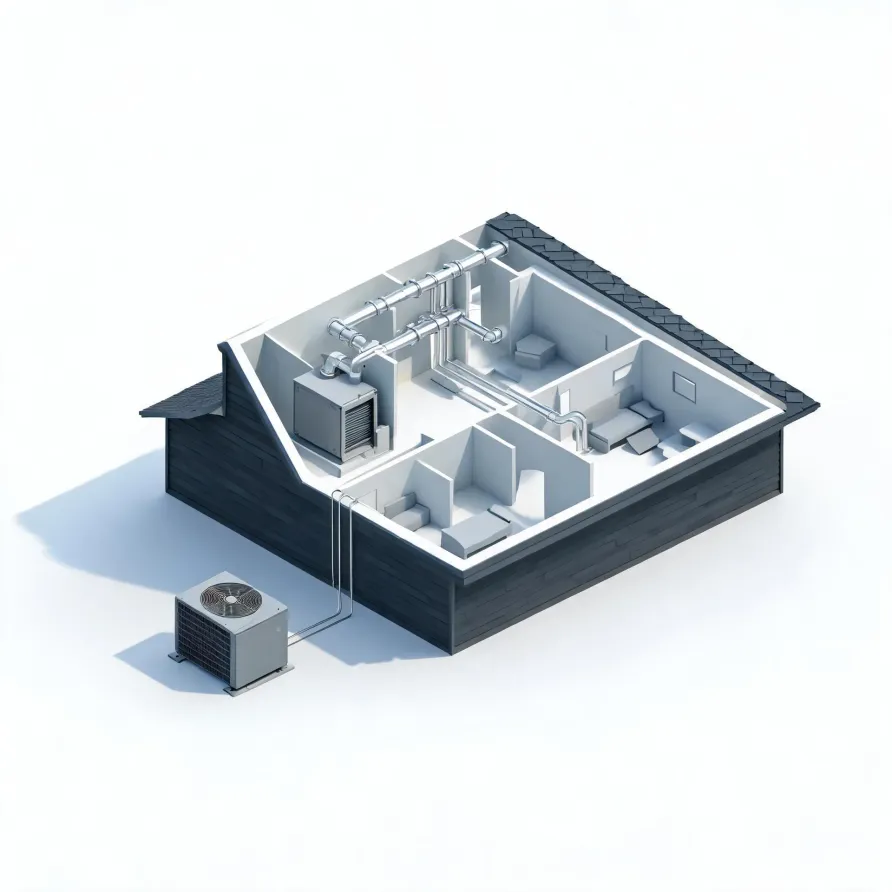
The outdoor condenser unit sits outside the house, usually on a concrete pad at ground level, and holds the compressor and condenser coil. The compressor is the part that does the heaviest work, and a contractor goes there early when a system stops cooling or starts making noise. The condenser coil wraps around it and is the first thing checked when the unit runs but the house stays warm.
Inside the house, the air handler holds the evaporator coil and the blower. The evaporator coil is a common source of problems when you see ice forming on the unit or water pooling beneath it. The blower pushes conditioned air into the supply ducts, and its motor is what a contractor looks at when airflow has dropped off. The expansion valve sits between the two coils and controls refrigerant flow; a fault there can read like a compressor problem until a contractor measures pressures on both sides.
The drawing shows the general layout of a central AC system, and a licensed contractor determines which components and conditions apply to your specific home.
Get matched in Williamsburg cityWilliamsburg by the Numbers
21 severe weather events were recorded in Williamsburg city, Virginia between 2015 and 2024.
NOAA National Centers for Environmental Information, Storm Events Database, bulk CSV export, events 2015-01-01 through 2024-12-31.Half the homes in Williamsburg city, Virginia were built in 1987 or earlier (2020-2024 ACS 5-year).
U.S. Census Bureau, 2020-2024 American Community Survey 5-Year EstimatesWilliamsburg city, Virginia holds 5,799 housing units (2020-2024 ACS 5-year).
U.S. Census Bureau, 2020-2024 American Community Survey 5-Year EstimatesOwners occupy 53.2% of the occupied homes in Williamsburg city, Virginia (2020-2024 ACS 5-year).
U.S. Census Bureau, 2020-2024 American Community Survey 5-Year EstimatesRules and Standards Behind Central AC Repair in Williamsburg city, Virginia10 sourced rules and standards
What HVAC Repair Looks Like in Williamsburg
Split-system central air conditioners rated below 45,000 Btu/h manufactured on or after January 1, 2023 must meet a federal minimum of 13.4 SEER2.
Split-system central air conditioners rated at or above 45,000 Btu/h manufactured on or after January 1, 2023 must meet a federal minimum of 13.4 SEER2.
Split-system central air conditioners manufactured between January 1, 2015 and December 31, 2022 had to meet 13 SEER, the metric that preceded SEER2.
Single-package central air conditioners manufactured on or after January 1, 2023 must meet a federal minimum of 13.4 SEER2.
Space-constrained central air conditioners manufactured on or after January 1, 2023 must meet a federal minimum of 11.7 SEER2.
Federal efficiency standards for split-system central air conditioners and heat pumps are set on each certified combination of outdoor unit and indoor coil rather than on the outdoor unit alone.
Residential and light commercial air conditioning and heat pump systems assembled in the field, including mini-splits and unitary systems, may not be installed on or after January 1, 2025 using a refrigerant with a global warming potential above 700.
A field-assembled system whose specified components were all manufactured or imported before January 1, 2025 carries no installation compliance date under the refrigerant restrictions and may still be installed.
Contractor Requirements in Williamsburg city, Virginia
Virginia’s contractor licence classes start above $1,000: the entry class covers a single contract or project over $1,000 but less than $30,000, or less than $250,000 of work in any 12-month period, with larger classes above that.
Virginia requires a contractor licence: no person may engage in, or offer to engage in, contracting work in the Commonwealth without one.